
UX research does not improve a product merely because interviews were completed, notes were grouped or a report was shared. Its value appears when evidence changes what a team decides to design, prioritise or test.
Turning UX research into better design decisions means building a traceable path from observations to patterns, insights, opportunities, options and testable actions. Research informs the decision; it rarely dictates one perfect interface. Designers still need to weigh user needs alongside accessibility, content, business goals and technical constraints.
This guide is for UX beginners, students and career switchers who can gather research but are unsure what should happen next. It explains a practical synthesis-to-decision workflow, using a fictional course-discovery experience as an example.
From research to decision in seven steps
- Clarify the decision: know what the team needs to learn or choose.
- Prepare the evidence: turn notes into specific, traceable observations.
- Find patterns: group evidence without hiding contradictions.
- Write insights: explain why a supported pattern matters.
- Frame opportunities: state the outcome without prescribing the interface.
- Compare options: assess user value, feasibility, risk and goals.
- Act and learn: record the decision, prototype it and test the uncertainty.
01 Start with the decision, not the research artefact
Before analysing a study, restate the decision it was intended to support. “Understand learners” is too broad. “Decide which information first-time learners need before they can shortlist a course” gives the analysis a practical destination.
A useful decision brief names:
- the audience and context included in the study;
- the behaviour, problem or uncertainty being investigated;
- the decision owner and when a decision is needed;
- important business, content, accessibility and technical constraints; and
- what evidence would be strong enough to act now or require more research.
This prevents a common failure: producing a polished journey map or slide deck that nobody can connect to the next product choice. If the team cannot name the decision, pause before turning every note into an “insight.”
02 Build an evidence chain you can trace
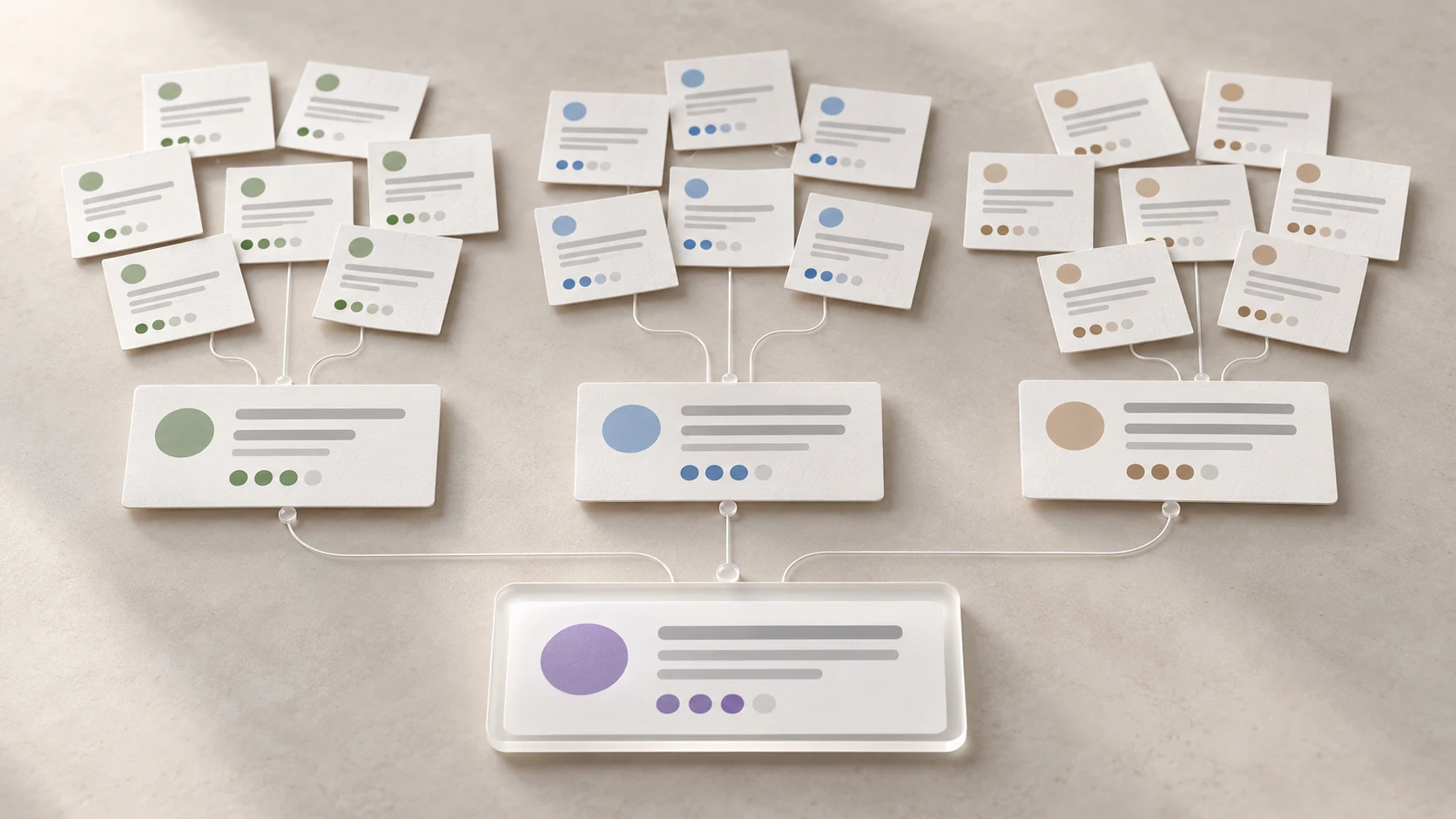
Good synthesis preserves the path back to what actually happened. Start with atomic observations: one clear behaviour, event or relevant statement per note, with enough context to understand it later. “Participant compared course duration before opening the curriculum” is more useful than “duration matters.”
Then move through distinct levels:
- Observation: what happened in a particular context.
- Pattern: related evidence recurring across relevant participants or data sources.
- Finding: a concise statement describing the supported pattern.
- Insight: an interpretation of why it happens or why it matters.
- Opportunity: a focused outcome the design could support.
- Decision: what the team will do, defer or investigate next.
These terms are used differently across organisations. The labels are less important than keeping description, interpretation and action separate. That separation makes weak leaps visible and helps another team member challenge the reasoning without dismissing the research.
03 Find patterns without flattening the evidence
Affinity mapping is a useful technique, not a machine that automatically produces truth. Group observations because they express a meaningful relationship, then name the relationship in plain language. Avoid vague clusters such as “navigation” or “feedback”; they describe a topic, not what users experienced.
Suppose five prospective learners explore a fictional course website. Three look for schedule and duration before reviewing modules. One goes directly to fees. Another wants to know whether the course assumes prior experience. A weak synthesis says, “Users want more information.” A stronger finding says, “Learners check different suitability conditions before they invest attention in detailed curriculum content.”
Do not count mentions as if every study were a survey. In qualitative research, recurrence can make a pattern more credible, but a serious accessibility barrier observed once may still deserve immediate attention. Record:
- which participants or sources support the pattern;
- the contexts in which it appeared;
- evidence that contradicts or limits it;
- whether the sample included the users most affected; and
- how confident the team is, with a short reason.
If you are new to study planning and evidence quality, first review UX research methods and process. Better decisions begin with research suited to the question.
04 Write insights that explain, not decorate
An insight should help the team understand a tension, motivation or cause that changes how it sees the problem. It should not merely restate an observation with the words “users need.”
Using the course example:
- Observation: a learner opens several pages to locate schedule, duration and entry requirements.
- Finding: suitability information is distributed across pages and is checked before detailed curriculum content.
- Insight: learners are not ready to compare course depth until they can rule out options that do not fit their circumstances.
The insight changes the design question from “How can we make the curriculum page more engaging?” to “How can we help a learner judge basic suitability before asking them to compare details?” That is a meaningful shift in direction.
Check every proposed insight with three questions: What evidence supports it? What alternative explanation could fit the same evidence? What decision becomes clearer if we believe it? If the third answer is “none,” the statement may be interesting but not yet actionable.
05 Turn insights into focused opportunities
An opportunity statement creates space for more than one solution. “Add a comparison table above the fold” is already a design. “Help first-time learners confirm whether an option fits their time, experience and availability before they compare curricula” describes an outcome.
A practical opportunity statement includes:
- the user or situation in scope;
- the outcome the experience should support;
- the barrier or tension identified in research; and
- important boundaries, such as not hiding eligibility details or creating false certainty.
You can also phrase the opportunity as a “How might we” question, provided it remains narrow enough to guide ideas and open enough to allow alternatives. Generate several responses: a filter, a short suitability summary, a guided comparison, clearer course-card content or a revised information structure may all address the same underlying need.
06 Prioritise the problem before polishing the solution
Not every finding should enter the backlog, and not every recurring request should become a feature. Prioritisation should make the team's reasoning explicit rather than allowing the loudest stakeholder or most polished concept to win.
Compare opportunities using criteria appropriate to the project:
- User impact: how strongly does the issue affect a meaningful goal?
- Reach: which users and situations are affected?
- Severity and risk: what happens if the issue remains, especially for access, trust or safety?
- Evidence confidence: how direct, relevant and consistent is the support?
- Strategic relevance: does it contribute to the product or service outcome?
- Effort and dependencies: what content, policy, data or technical work is required?
- Learning value: will a small experiment resolve a costly uncertainty?
Use numbers lightly. A score can support discussion, but it cannot remove judgement or make incomparable evidence precise. Write the rationale beside the rating and separate urgency from confidence. A high-risk accessibility issue with limited evidence may call for immediate investigation rather than a low priority.
07 Compare design options against the evidence

Research identifies needs, barriers and behaviours; it does not draw the final screen. Once several ideas exist, evaluate them against the opportunity and constraints. For the suitability problem, a large comparison table might expose useful details but overwhelm a phone screen. A guided questionnaire might narrow options but demand answers the organisation cannot interpret reliably. A concise course summary could be easy to implement yet insufficient for unusual circumstances.
A simple option review can record:
- which evidence and user outcome the option addresses;
- what assumptions it introduces;
- which users or edge cases it may exclude;
- content and accessibility implications;
- technical or operational dependencies; and
- the cheapest realistic way to test it.
This is where multidisciplinary participation matters. Researchers protect the meaning and limits of the evidence. Designers explore interaction and content responses. Developers and operational colleagues expose feasibility and service constraints. Product owners connect the choice to outcomes and sequencing. Shared analysis reduces the chance that research becomes a handoff document interpreted in isolation.
08 Convert the choice into a testable hypothesis
A decision is stronger when the team states what it expects to happen and what could prove it wrong. One useful structure is:
Because we observed [evidence], we believe [design response] will help [audience] achieve [outcome]. We will learn whether this is true by observing [behaviour or result] in [test or measure].
For example: “Because prospective learners checked suitability before curriculum depth, we believe a concise, consistent suitability summary on each course page will help first-time visitors decide which options deserve closer comparison. We will test whether they can identify a plausible option and explain why without searching across several pages.”
The hypothesis does not claim that the team already knows the answer. It connects the proposed design to the evidence and creates a specific learning goal for a prototype or usability study. The wider UX design process then continues: make the idea tangible, evaluate it and revise the decision when new evidence appears.
09 Keep a lightweight decision record
Research loses influence when its context disappears after a workshop. A decision record can be a table, ticket or short document. It should be easy to update and easy for someone outside the session to understand.
For each important decision, capture:
- the decision and date;
- the owner and collaborators;
- the research question and relevant evidence;
- the insight or opportunity being addressed;
- options considered and important trade-offs;
- the selected action and why;
- confidence, assumptions and unresolved questions; and
- the next validation step and later result.
This record is not bureaucracy for its own sake. It prevents the same debate from restarting without new information, shows when a decision relied on weak evidence and makes later learning easier to incorporate. It is also excellent material for a portfolio case study because it demonstrates judgement rather than only finished screens.
10 Common mistakes when applying UX research
- Jumping from one quote to a feature: a memorable comment is not automatically a pattern or priority.
- Counting qualitative mentions mechanically: context and consequence can matter more than frequency.
- Writing circular insights: “users need an easier experience because the experience is difficult” adds no explanatory value.
- Hiding contradictory evidence: disagreement may reveal distinct user groups, contexts or an unclear research question.
- Confusing preference with performance: what someone says they like may differ from what helps them complete a task.
- Letting research prescribe the UI: findings should frame the problem and evaluation criteria, not eliminate design exploration.
- Ignoring constraints until handoff: an idea that depends on unavailable data or unsupported operations is not yet a viable decision.
- Stopping after the presentation: assign an owner, next action and validation method before the research loses momentum.
11 A practical exercise for your first case study
Choose a small, low-risk experience you can research ethically, such as how learners compare a few fictional workshops. Define one decision, conduct a small study and preserve the evidence trail.
- Write the decision brief and the assumptions you are testing.
- Capture atomic observations with participant and context references.
- Group evidence, name patterns and retain exceptions.
- Write two or three findings and at least one alternative explanation for each.
- Turn the strongest finding into an insight and focused opportunity.
- Sketch three different responses to the opportunity.
- Compare the options using explicit criteria and record your choice.
- Build only enough prototype to test the riskiest assumption.
- Run a usability session, update the decision record and show what changed.
The result is more valuable than a screen-redesign exercise because it shows how evidence influenced your judgement. For a broader foundation in roles and collaboration, read what a UI/UX designer actually does.
12 Better decisions remain open to better evidence
The goal of UX research is not to remove uncertainty or give design choices a scientific appearance. It is to replace unsupported assumptions with a clearer, more accountable basis for action.
Keep the chain visible: observation, pattern, insight, opportunity, option, decision and validation. When new evidence contradicts an earlier choice, that is not a failure of the process. It shows the process is working, provided the team is willing to revise what it builds.
Want to practise turning research into flows, interfaces, prototypes and testable decisions? Explore Zolve Academy's Professional UI/UX Design & AI-Powered Workflow Program, review the curriculum and use the course enquiry option to discuss your starting point and project goals.
FAQ
Common questions about How to Turn UX Research Into Better Design Decisions
A quick summary of the most common questions readers have about this topic.
Start with traceable observations, group related evidence into patterns, interpret why those patterns matter, frame focused opportunities and compare possible responses against user value, business goals, feasibility, accessibility and risk. Record the chosen action, the evidence behind it and what you will test next.
A finding describes a supported pattern in the evidence, such as several participants missing eligibility information. An insight explains the underlying tension or meaning, such as people needing to confirm suitability before they are ready to compare details. An insight should help the team see the problem differently and guide action.
No. Some findings are isolated, outside the study scope, already addressed or too uncertain to justify immediate action. Teams should consider evidence strength, impact, frequency, risk and strategic relevance, then decide whether to act, investigate further, monitor or deliberately take no action.
Return to the research question, participant context and supporting evidence. Separate different user groups or situations instead of forcing one universal answer, assess the consequences of getting the decision wrong and use an explicit prioritisation method. If uncertainty remains important, design the smallest useful follow-up study or prototype test.
Keep a simple decision record linking the observation, pattern, insight, opportunity, chosen response and validation result. In a portfolio case study or team review, show the relevant evidence, alternatives considered, trade-offs and what changed after testing rather than claiming that research directly dictated the final screen.